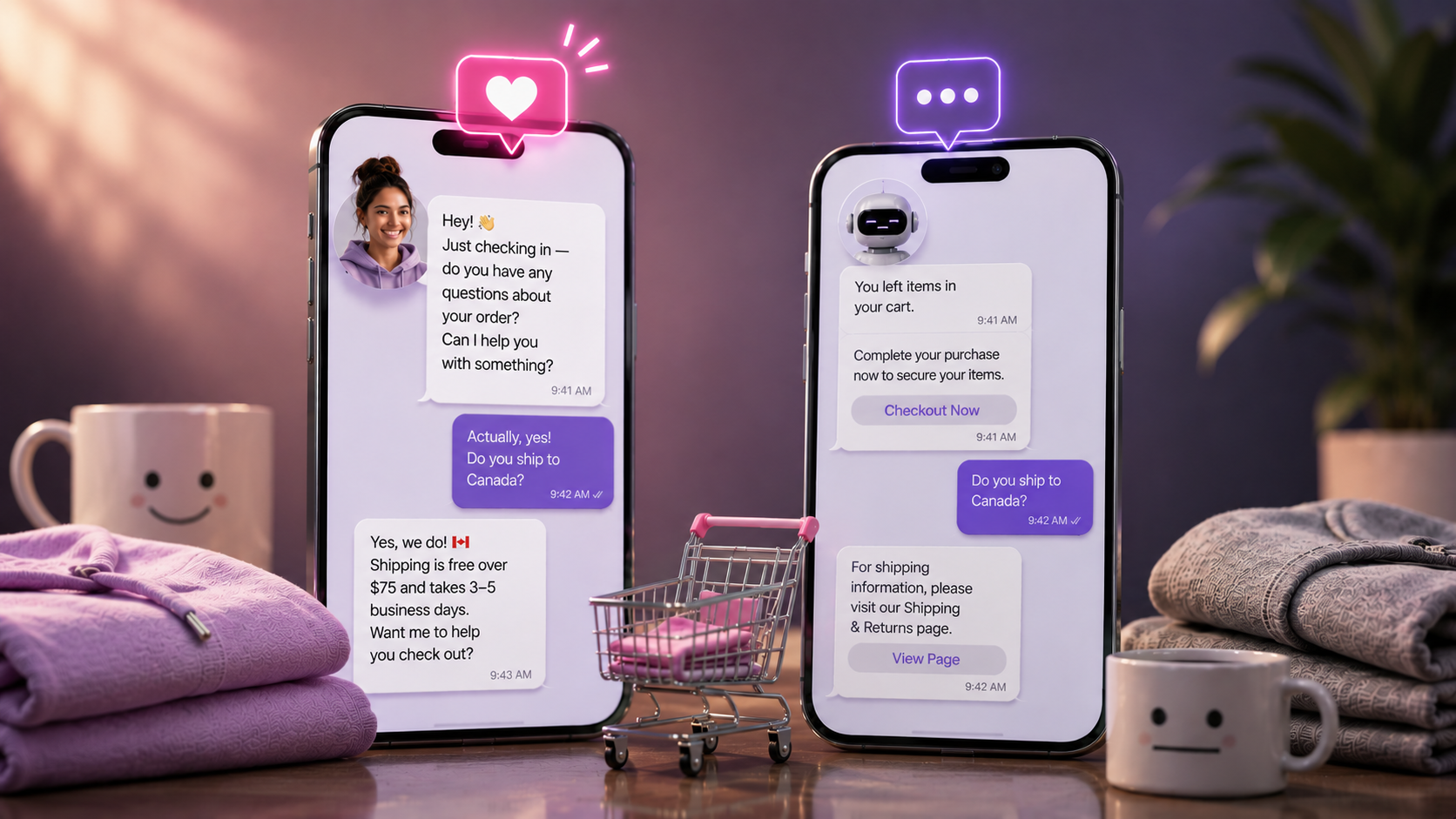
Hot take: In the human vs AI SMS cart recovery debate, the data isn't even close. 79% of consumers prefer talking to a real person. AI chatbots hallucinate in 15-30% of complex responses. And human-powered SMS converts at 2-5x the rate of your automated flows. Your bot is costing you money. Here's the proof.
Seven out of every ten people who add something to your cart leave without buying. Globally, that's over $4 trillion in abandoned merchandise every year, according to Baymard Institute. Yes, trillion with a T. For Shopify merchants, that's not a fun stat to drop at a dinner party. That's revenue walking out of your store every single day.
SMS is the best channel to win those sales back. Open rates above 90%, a 45% response rate (compared to 10% for email, per Sakari), and customers actually reading your messages within three minutes. But here's the question most brands skip over: who is sending those messages?
A bot? A real person? Because the answer changes everything. The difference between a human vs AI SMS cart recovery approach isn't just about tone. It's about your conversion rates, your customer trust, and whether those shoppers come back next month or never think about your brand again.
The $4 Trillion Problem Nobody Is Solving Well
The global cart abandonment rate is 70.22% in 2026, per Baymard Institute. On mobile (where 72% of your e-commerce traffic comes from), it climbs to 80-85%. That gap between desktop and mobile abandonment is roughly 15 percentage points, and it hasn't budged despite years of mobile checkout improvements.
Here's the thing. Your customers aren't being irrational. They're telling you exactly why they left: unexpected costs at checkout (48%), mandatory account creation (26%), and slow delivery estimates (23%). The brands recovering the most carts are the ones that actually listen and respond to those reasons. Individually. Not with a templated "Did you forget something?" text.
This is where SMS stands apart from email. A text gets read in three minutes. It invites a reply. It feels like a conversation, not a newsletter blast. But that conversational promise only works if someone (or something) on the other end can actually hold a conversation.
How AI Chatbots Handle Cart Recovery
Let's be real: AI-powered SMS recovery does have strengths. Bots can send thousands of messages at once, they run around the clock, and they handle simple interactions without human labor costs. For straightforward scenarios (a customer forgot about their cart, a quick discount nudge closes the deal), automation works fine.
The data backs this up for basic use cases. According to Chatbot.com, 82% of customers prefer chatbots for simple stuff like order status checks or basic FAQs. And in well-implemented systems, AI can handle 65-80% of inbound conversations automatically, per Conferbot.
The cost argument is real, too. AI customer service is a $15.12 billion market in 2026, projected to reach $47.82 billion by 2030 (NextPhone). Brands adopt it because it scales without scaling headcount.
But there's a ceiling. And most brands hit it faster than they expect.
Where AI Falls Short (And the Data Proves It)
Here's what the data actually shows (and it's not what the AI hype cycle wants you to believe).
Your customers prefer humans. Overwhelmingly. A 2026 SurveyMonkey study found that 79% of Americans prefer interacting with a human over an AI agent. Only 2% want to deal exclusively with generative AI chatbots, according to GrooveHQ. Two percent. When asked why, 61% said humans "understand their needs better," 53% cited "more thorough explanations," and 52% said human interactions are "less frustrating."
AI gets it wrong. Often. AI chatbots hallucinate in 15-30% of customer service responses, according to Suprmind. Fabricated policies. Incorrect product details. Nonsensical answers. These aren't edge cases. Air Canada got held legally liable after its chatbot promised a customer a bereavement fare discount that didn't exist. Cursor, the AI coding tool, saw subscription cancellations spike after its AI agent invented a fictional usage policy. Invented it. Out of thin air.
Even the AI-first companies are walking it back. Klarna, the buy-now-pay-later giant, replaced roughly 700 human agents with AI in 2024. Big press release. Lots of congratulations from the tech press. Then they publicly reversed the strategy. CEO Sebastian Siemiatkowski admitted they focused too much on efficiency over quality. They're now rehiring human agents. Awkward.
And here's the deeper trust problem. A 2026 Gartner survey found that 50% of U.S. consumers would prefer brands that don't use generative AI in customer-facing messages. Half your audience. Consumers detect AI by responses arriving too fast (50%) and sounding too formal or robotic (49%), per Klaviyo. The moment your customers suspect they're talking to a bot, trust drops. And so does conversion.
Why Human SMS Conversations Convert Higher
Here's what most brands don't realize: cart recovery isn't a simple transaction. A customer who abandoned a $200 cart isn't the same as someone checking an order status. They have objections. They have questions. They need a reason to come back. And that reason is almost never a generic 10%-off code.
Real agents handle what bots literally cannot:
- Emotional objections. "I'm not sure this is the right size." "I need it by Friday, will it arrive in time?" "I found something similar for less." These require empathy, judgment, and real-time problem-solving. Your chatbot is going to serve a coupon. A human is going to have a conversation.
- High-value cart nuance. A $500 cart with three items needs a different conversation than a $30 impulse buy. Human agents read the situation and adjust. Bots run the same script regardless.
- Trust-building. When a real person responds to your text, it signals that the brand actually cares. That signal is worth more than any discount code you could throw at them.
The conversion data tells the story. Brands using human-powered SMS recovery see 2-5x higher conversion rates compared to automated flows. The returning customer flow converts at 46.9% with a 45.3% reply rate. And here's the stat that should make you rethink your entire cart recovery strategy: for every one customer who redeemed a discount code, 3.7 more purchased without one. The conversation drove the sale. Not the incentive.
Human agents also outperform AI on customer satisfaction by 15-25 percentage points in scenarios involving emotional complaints or complex resolution, per industry benchmarks. When every interaction is a chance to either save or lose a customer relationship, that gap is the whole ballgame.
Human vs AI SMS: A Side-by-Side Comparison
| Factor | AI Chatbot SMS | Human-Powered SMS |
|---|---|---|
| Response speed | Instant (seconds) | Fast (1-3 minutes) |
| Availability | 24/7 | Extended hours (varies) |
| Cost per conversation | Lower | Higher (offset by conversion) |
| Simple cart nudges | Strong | Adequate |
| Complex objections | Weak (15-30% error rate) | Strong |
| Personalization | Template-based | Fully adaptive |
| Customer trust | Low (50% prefer no AI) | High (79% prefer human) |
| Conversion rate | Baseline | 2-5x higher |
| Revenue per message | Lower | Higher |
Look at that table. AI wins on speed and cost. Humans win on everything that actually drives revenue. For any Shopify merchant evaluating abandoned cart SMS strategies, the question isn't which is cheaper per message. It's which recovers more dollars per cart. Those are very different questions.
The Hybrid Model: AI for Triage, Humans for Revenue
The smartest brands aren't choosing between human and AI SMS. They're using both, strategically.
Here's how the hybrid model works. AI handles the initial triage: identifying abandoned carts, segmenting by value, sending the first touch. For low-value carts or simple recovery scenarios, automation closes the loop. But the moment a customer replies with a question, an objection, or anything beyond a one-word answer? A real human steps in.
This matches what your customers actually want. According to Oscar Chat, 69% of users prefer knowing a human backup exists when interacting with automated systems. Even customers who are fine with a bot want to know a real person is available if things get complicated. The safety net matters.
The economics work, too. AI reduces the cost of the first touch. Humans maximize conversion on the conversations that actually move revenue. You're not paying human rates for every abandoned cart, just the ones where human skill makes the difference between a recovered sale and a lost customer.
For Shopify merchants doing $1M+ in annual revenue, the math is straightforward. If human-powered SMS recovers even 5% more abandoned carts than pure automation, the additional revenue far exceeds the cost difference. At a 70% abandonment rate and a $75 average order value, recovering an extra 5% on 10,000 monthly sessions means roughly $26,000 in additional monthly revenue. That's not a rounding error. That's a hire.
Key Takeaways
- Your abandoned carts represent over $4 trillion globally. SMS is the highest-performing recovery channel with 90%+ open rates and 45% response rates.
- AI chatbots work for simple, high-volume interactions but hallucinate in 15-30% of complex responses and actively erode your customers' trust.
- 79% of consumers prefer human interaction. Only 2% want to deal exclusively with AI chatbots. Two percent.
- Human-powered SMS cart recovery converts at 2-5x the rate of automated flows, with higher satisfaction and stronger brand loyalty.
- The hybrid model (AI for triage, humans for revenue) delivers the best ROI for growing Shopify brands.
- Even AI-forward companies like Klarna have reversed their automation-only strategies after watching quality and satisfaction tank.
FAQ
What is human-powered SMS cart recovery?
Real people texting your customers who abandoned their carts. Not chatbots. Not scripts. Live agents who read the customer's cart, understand their situation, and have a genuine conversation to address objections and close the sale. Your customers get someone who actually listens and adapts in real time, not a template that fires regardless of context.
What conversion rate should I expect from SMS cart recovery?
Automated SMS cart recovery typically converts at 10-15%, which already beats email (5-10%). Human-powered SMS recovery pushes that to 20-45% depending on your brand, product category, and cart value. The gap is widest on high-value carts where customers have specific questions or objections that bots simply can't handle.
Can I use both AI and human SMS for cart recovery?
Yes, and most scaling brands should. Use AI to identify abandoned carts, segment by value, and handle the first automated touch. Route replies and high-value carts to human agents who can have real conversations. This hybrid approach keeps your costs manageable while maximizing recovery on the carts that actually matter.
Is human SMS cart recovery worth the cost for small Shopify stores?
If your AOV is above $50 and you're processing more than 500 orders per month, human-powered recovery typically pays for itself many times over. The metric that matters is revenue recovered per dollar spent, not cost per message. A $5 human conversation that recovers a $150 cart is a better investment than a $0.05 bot message that doesn't.
Why are companies moving away from AI-only customer service?
Because the data caught up with the hype. Companies like Klarna found that replacing humans with AI cut costs but also cut quality, satisfaction, and ultimately revenue. A 2026 Gartner survey found that 50% of consumers actively prefer brands that don't use generative AI in customer-facing interactions. The pattern is the same everywhere: AI works for simple tasks, but human judgment is irreplaceable for complex, emotional, or high-stakes conversations.
Your abandoned carts aren't a technology problem. They're a conversation problem. The brands recovering the most revenue are the ones having real conversations with real customers at the moment it matters most. Want to see what that looks like for your store? Try LiveRecover on the Shopify App Store. You're live in under five minutes, and you'll see recovered revenue within days.